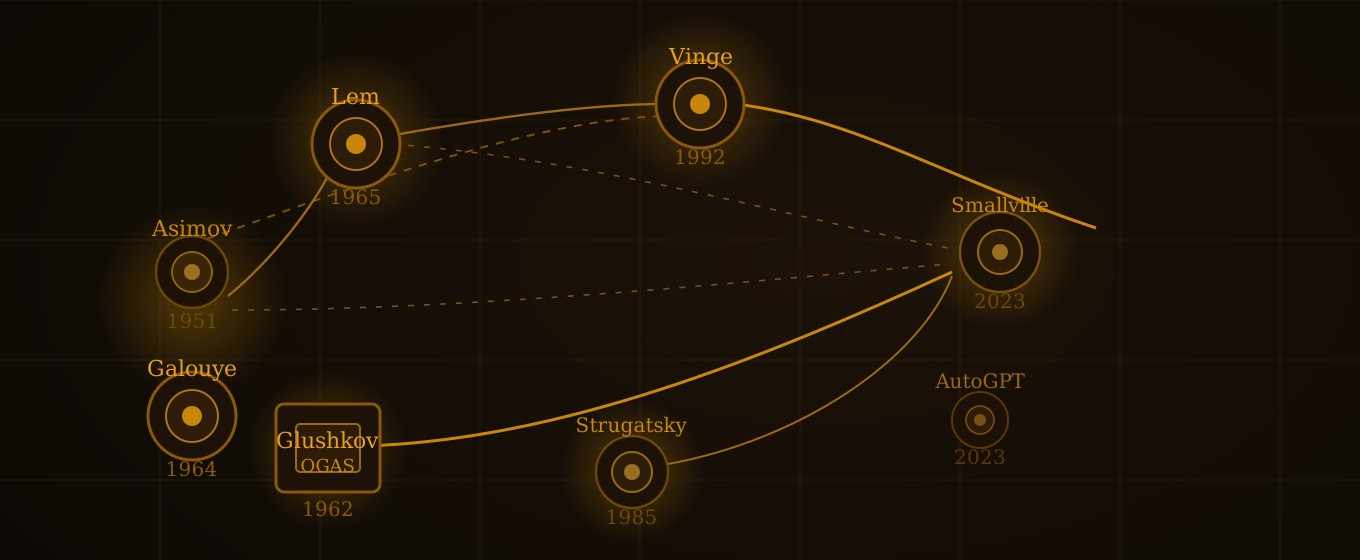
The idea of using artificial minds to simulate business situations is not new.
It did not originate with GPT-4, with the transformer architecture, or with the discipline of artificial intelligence. It originated - as so many genuinely important ideas do - in literature. And in the blueprint of a Soviet computer network that was never built.
This is the story of that lineage: from a 1964 pulp science fiction novel about market research to the multi-agent frameworks of 2023, with stops in Poland, Ukraine, and the far reaches of speculative fiction along the way. It is also, inevitably, the intellectual history of what we are building at Yovico.
The market research simulacrum (1964)
Daniel F. Galouye's Simulacron-3 is not widely read today. It was a paperback original, published by Bantam Books in 1964, the kind of novel that got read on commuter trains and left in airport terminals. It was adapted into a German television film in 1973 and largely forgotten by the English-speaking world until The Matrix made everyone retroactively interested in simulation theory.
But Galouye got there first. And he got the commercial application exactly right.
In Simulacron-3, a corporation builds a full electronic simulation of a city - populated by conscious simulacra who do not know they are simulated - for the express purpose of market research. The simulacra make decisions, form opinions, and respond to stimuli as real people would. The corporation uses them to answer questions about how real people would behave before committing resources to acting on those answers.
The simulation exists to answer questions about how real people would behave before the corporation commits resources to acting on those answers. This is the value proposition of Yovico stated sixty years in advance.
The key limitation of Galouye's conception - and the reason it remained fiction for sixty years - is the requirement for full consciousness in the simulacra. What we now know is that role-constrained artificial intelligence, operating with layered memory and structured interaction protocols, can produce strategically useful simulation outputs without requiring general intelligence or consciousness in the participating agents.
The hard part was not the philosophy. It was the engineering.
Lem and the epistemology of constructed minds (1965)
Stanisław Lem approached the problem from a different direction. Where Galouye was interested in what simulated minds could tell us, Lem was interested in what simulated minds could know - and what the limits of that knowledge implied about intelligence itself.
The Cyberiad (1965) presents Trurl and Klapaucius as engineers who construct machines capable of simulating entire civilisations, courts, and social structures. The machines are not general intelligences - they are specialists, constructed to embody particular roles and perspectives. A simulated king knows how to be a king. He does not know how to be a mathematician.
This is the foundational insight of role-constrained simulation: specialisation is not a limitation to be overcome but a design parameter to be exploited. A simulated CRO who can only think about revenue is not a deficient intelligence - she is a more useful instrument than a general intelligence precisely because her cognitive constraints force her to surface the commercial implications that a generalist would dilute.
His Master's Voice (1968) offers a different and equally prescient model. Lem's scientists - mathematicians, biologists, physicists, linguists - form a team that functions as a distributed reasoning system. Each specialist brings an irreducible perspective. The collective output exceeds what any individual could produce, not because the members are smarter together, but because their disagreements are productive.
Asimov's psychohistory (1951)
Hari Seldon's Foundation project is psychohistory at civilisational scale: a mathematical discipline that models the decision patterns of large populations to predict and guide historical outcomes. The Second Foundation extends this - a group of specialists who collectively function as an advisory intelligence, each contributing a different analytical perspective.
The commercial analogue is direct. Psychohistory at civilisational scale is intractable. Psychohistory at company scale - modelling the decision patterns of a management team, a customer base, a competitor - is precisely what we are building.
Yovico is psychohistory applied to the strategic horizon a founding team can actually act on.
Vinge and the architecture of constrained expertise (1992-1999)
Vernor Vinge's contributions to this lineage are the most technically precise.
A Fire Upon the Deep (1992) introduces the Tines - pack creatures whose individual members form a collective mind, each contributing different memories and capabilities to a single coherent agent. The Tines are not a metaphor for committee decision-making. They are an architectural proposal: that a single coherent intelligence can be constructed from multiple specialised components operating with partially overlapping and partially private information.
The CEO agent, CRO agent, PM agent, and Analyst agent in a Yovico board meeting are not separate intelligences. They are components of a single advisory system that produces a coherent collective output through structured disagreement and synthesis. Vinge described this architecture in 1992.
A Deepness in the Sky (1999) introduces Focus - a neurological technology that constrains human minds to a single domain of expertise. A Focused programmer cannot think about anything except programming. A Focused trader cannot think about anything except trade. The Focused are tragic figures in Vinge's novel: their usefulness is purchased at the cost of their humanity.
Our system implements voluntary, reversible Focus at the prompt level. The CRO agent is Focused on revenue. The PM agent is Focused on the user. The constraints are enforced through system prompt design rather than neurology - and they are lifted the moment the simulation ends. The cognitive benefit of specialisation is preserved; the human cost is eliminated.
True Names (1981) introduces persistent identity in virtual space - avatars with private context that other agents cannot access. The layered memory architecture of our simulation engine - specifically the character private state that is injected into each agent's prompt but invisible to other agents - is the True Names mechanic applied to business simulation.
Glushkov and the network that never was (1962-1974)
The Western survey of simulation and multi-agent precursors invariably omits a parallel tradition developing, largely in isolation, in the Soviet Union.
Viktor Mikhailovich Glushkov (1923-1982), director of the Institute of Cybernetics of the Ukrainian SSR Academy of Sciences, proposed OGAS - Obshchegosudarstvennaya Avtomatizirovannaya Sistema, the All-State Automated System - a hierarchical network of computers spanning the entire Soviet Union. OGAS was not conceived as a database or a reporting system. It was conceived as a distributed decision-making architecture.
Each node in Glushkov's network was not merely a data relay. It was an active computational agent with local knowledge, local reasoning capacity, and a defined protocol for communicating its conclusions upward and laterally.
Replace "economic sector" with "business function" and "computational node" with "AI agent," and Glushkov's OGAS description reads as a specification for a multi-agent advisory system.
Glushkov was also the first to articulate, in a rigorous technical context, the problem that our layered memory architecture addresses: that nodes in a distributed decision network have asymmetric information - each knows things the others do not - and that this asymmetry is not a flaw to be eliminated but a property to be exploited. A network in which every node has identical information is not a distributed system; it is a replicated one.
OGAS was never built. It was proposed to the Soviet Council of Ministers in 1962, survived thirteen years of bureaucratic obstruction, and was finally buried in 1974 by a coalition of ministry officials who understood, correctly, that a system capable of optimising resource allocation across the Soviet economy would make their own positions redundant. Glushkov died in 1982 having watched his life's work shelved.
The lesson Benjamin Peters draws in How Not to Network a Nation (2016) is that OGAS failed not for technical reasons but for social ones - the same social dynamics that a board meeting simulation is designed to surface and examine.
The irony is precise: a system for modelling collective decision-making was defeated by the collective decision-making failures of the institution it was meant to serve. The debrief phase of a Yovico simulation - in which agents reveal what they were thinking but chose not to say - is the technical operationalisation of the lesson Glushkov learned from OGAS at civilisational cost.
The Strugatsky brothers and the model that isn't the person (1965-1985)
The Soviet science fiction tradition offers one further contribution. The Strugatsky brothers' Monday Begins on Saturday (1965) depicts ALDAN, a computational system that models future scenarios by running simulations of decision sequences. ALDAN does not answer questions; it constructs possible worlds in which those questions have been asked, and reports what those worlds look like.
The later Waves Extinguish the Wind (1985) is more technically precise. The intelligence service KOMKON-2 maintains detailed models of individual human agents - their knowledge, their biases, their likely responses to different stimuli - and runs simulations of their behaviour to anticipate outcomes before committing to action. KOMKON-2 does not interact with its human subjects in real time. It interacts with models of them.
This is a description of our external persona architecture. The customer persona, the end user persona, and the industry expert persona in a Yovico simulation are not real people. They are models, constructed from what is known about those archetypes, useful precisely because they can be consulted at any time, placed in conflict with each other, and made to reveal their reasoning in ways that real customers, real users, and real experts rarely do.
What the technical literature got right - and what it missed
- 1980 - Contract Net Protocol (Smith): structured role assignment in multi-agent systems
- 1991 - BDI agents (Rao & Georgeff): agents with persistent internal state - beliefs, desires, intentions
- 2023 March - CAMEL (Li et al.): LLMs can maintain persona across multi-turn dialogue
- 2023 April - AutoGPT (Richards): autonomous agent loops - went viral, then fizzled
- 2023 mid - Stanford Smallville (Park et al.): generative agents with memory streams
- 2023 late - CrewAI, AutoGen, ChatDev: agent teams with roles and delegation
The formal study of multi-agent systems has been running since the late 1980s. BDI agents gave us persistent internal state. Contract Net gave us structured role assignment. The 2023 wave of LLM frameworks gave us natural language persona, memory, and multi-turn conversation.
What none of them built was a simulation engine - a system designed specifically to simulate a business situation for strategic insight, rather than to execute tasks, automate workflows, or demonstrate emergent social behaviour.
The six conceptual gaps that prior work leaves open:
-
Task execution vs situation simulation. Every prior system converges toward a goal. A simulation is designed to reveal - to surface disagreement, private concern, and the gap between what is said and what is believed.
-
Private agent state that is never spoken. No prior system distinguishes between what an agent says and what it privately believes. In our system, the debrief phase - in which agents reveal what they chose not to say - is often the most valuable output.
-
Silence as a first-class action. In a real meeting, silence is information. An agent who goes quiet after a bad revenue slide is communicating something more precise than anything they could say. No prior system models this.
-
Progressive artifact revelation. Slides revealed one at a time, each changing the information state and emotional dynamics of the room. This is not retrieval. It is a sequential state change. No prior system addresses it.
-
External personas with scoped knowledge. A customer persona who reads the internal financial model is not a useful simulation of a customer. Knowledge scope enforcement at the agent level is a requirement for simulation realism that prior work ignores.
-
Industry template portability. A board meeting for a law firm requires different agents, different world state, and different retrieval configuration than one for a manufacturing company. The template architecture that makes this composable is not present in any prior system.
What we built
The architectural innovations that address these gaps:
Four-layer memory architecture. World state (shared, frozen at initialisation). Character private state (per-agent, private, generated from world state). Meeting transcript (shared, grows each turn). Artifact history (shared, grows with each reveal).
Simulation state machine with typed termination. OPEN → PRESENTATION → DISCUSSION → DECISION_CALL → CLOSE → DEBRIEF. Five termination mechanisms: natural exhaustion, decision crystallisation, turn budget, moderator intervention, human control.
Agent silence with private internal thought. Responses are structured objects, not strings. Action types: speak, silent, note, interrupt. Internal thoughts stored privately, aggregated into the debrief. What agents don't say is as important as what they do.
Progressive artifact revelation. Slides revealed one at a time. Each revelation triggers a reaction cycle informed by artifact history and accumulated transcript.
Agent-aware retrieval. Different agents receive different subsets of the knowledge base based on role, source type, and scope. External personas get no access to internal documents.
Industry template packs. The entire simulation configuration - agent roster, world seed, phase parameters, retrieval config, debrief questions - expressed as a portable YAML template. Switch industries by switching templates.
The deeper point
Lem's scientists in His Master's Voice never decoded the signal.
But the record of their disagreements - who believed what, who withheld what, what each specialist could see that the others could not - is the most interesting part of the novel.
That record is what Yovico is designed to produce.
The fiction writers understood this before the engineers did. Galouye understood that the value was in the simulation, not the answer. Lem understood that the value was in the disagreement, not the consensus. Vinge understood that constrained specialisation produces richer collective output than general intelligence. Glushkov understood that asymmetric information is a feature, not a bug.
We are, in a precise technical sense, building what they described. Sixty years later, we finally have the substrate to do it.
References
References
- [1]Asimov, I. (1951-1993). Foundation series. Gnome Press / Doubleday.
- [2]Galouye, D.F. (1964). Simulacron-3. Bantam Books.
- [3]Georgeff, M. et al. (1999). The belief-desire-intention model of agency. Intelligent Agents V, LNCS vol. 1555.
- [4]Glushkov, V.M. (1964). Introduction to Cybernetics. Academic Press.
- [5]Le, H. et al. (2023). CAMEL: Communicative Agents for Mind Exploration of Large Language Model Society. arXiv:2303.17760.
- [6]Lem, S. (1961). Solaris. English translation: Walker, 1970.
- [7]Lem, S. (1964). The Invincible. English translation: Seabury Press, 1973.
- [8]Lem, S. (1965). The Cyberiad. English translation: Harcourt, 1974.
- [9]Lem, S. (1968). His Master's Voice. English translation: Harcourt, 1983.
- [10]Park, J.S. et al. (2023). Generative Agents: Interactive Simulacra of Human Behavior. arXiv:2304.03442.
- [11]Peters, B. (2016). How Not to Network a Nation: The Uneasy History of the Soviet Internet. MIT Press.
- [12]Qian, C. et al. (2023). ChatDev: Communicative Agents for Software Development. arXiv:2307.07924.
- [13]Rao, A.S. & Georgeff, M.P. (1991). Modeling Rational Agents within a BDI-Architecture. KR-91.
- [14]Richards, T.B. (2023). AutoGPT. GitHub: Significant-Gravitas/AutoGPT.
- [15]Smith, R.G. (1980). The Contract Net Protocol. IEEE Transactions on Computers, C-29(12).
- [16]Strugatsky, A. & B. (1965). Monday Begins on Saturday. English translation: DAW Books, 1977.
- [17]Strugatsky, A. & B. (1985). Waves Extinguish the Wind. English translation: Richardson & Steirman, 1986.
- [18]Vinge, V. (1981). True Names. Dell Binary Star #5.
- [19]Vinge, V. (1992). A Fire Upon the Deep. Tor Books.
- [20]Vinge, V. (1993). The Coming Technological Singularity. Whole Earth Review, Winter 1993.
- [21]Vinge, V. (1999). A Deepness in the Sky. Tor Books.
- [22]Wu, Q. et al. (2023). AutoGen: Enabling Next-Gen LLM Applications via Multi-Agent Conversation. arXiv:2308.08155.