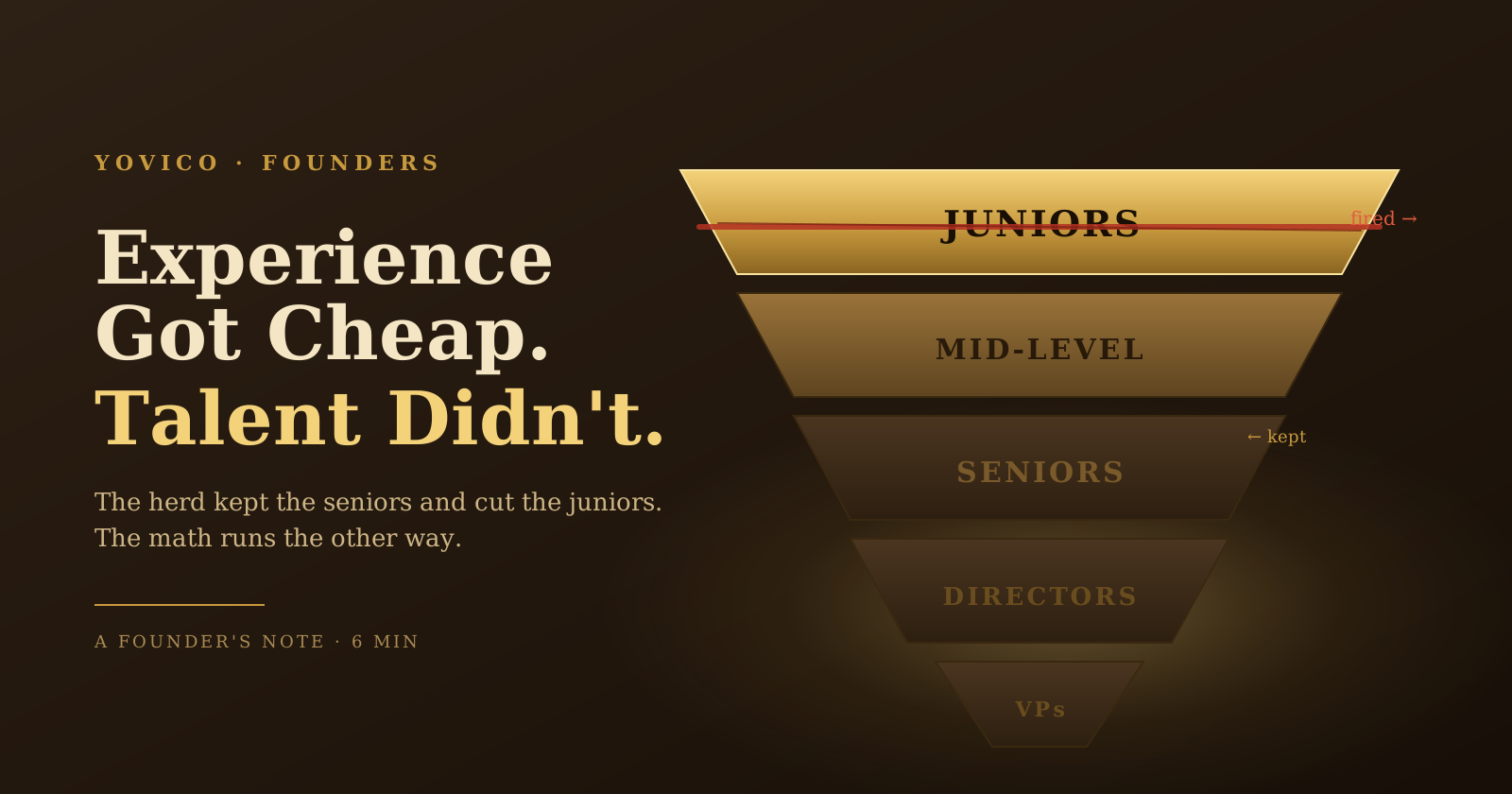
When the LLMs got good, most companies did the same thing: they fired the juniors. The logic was tidy. AI is a great assistant, seniors have judgment, juniors were the assistants, ergo juniors are redundant. Half of tech wrote the same memo.
I did the opposite. I hired recent grads and let the LLMs substitute for experience instead. My results have been, let's say, embarrassing for the consensus.
Experience is the most overpriced asset in the labor market right now.
Not useless. Overpriced. A decade of pattern-matching used to be a moat because the patterns lived in one person's head and you had to rent the head. That moat is now a Wikipedia article a model can summarize in four seconds. The senior's edge mostly wasn't wisdom, it was retrieval. And retrieval got commoditized while everyone was busy laying off the kids.
What didn't get commoditized: the discipline to actually finish things, and the raw ability to think. Smarts and conscientiousness. The two traits a century of psychometric research keeps identifying as the only ones that reliably predict job performance - and which polite society spent twenty years pretending away. They are now the entire game.
A sharp 23-year-old with Claude open in another tab is not a junior version of a senior. Different animal entirely. No twenty years of "this is how we've always done it" calcified into their decision-making. They ask the model the question a senior would be too proud to ask. Less ego in the first draft. And they cost a fraction.
What convinced me
About a year ago, we had an idea: an API interface sitting on top of managed, governed databases. API gateways are not new - that part of the market is a graveyard of incumbents. The only interesting version of the idea was a codeless one, where an agent wrote the API. I floated it on a Friday. My son, a recent grad working at the company, listened. On Monday morning he showed me a working version.
One weekend. No agent frameworks. No MCP. No tool-use abstractions. Just a kid who took an idea seriously and a model he treated as a colleague rather than a curiosity.
My son is a chemical engineer. His buddy on the project is a physics major. Neither of them has a CS degree. They are, by every credentialing heuristic the industry uses, the wrong people to build infrastructure software. They built it anyway, faster than the right people would have, because the right people would have been busy explaining why it couldn't be done that way.
We're back in the 90s
Process matters less. Credentialing matters less. Crossovers from adjacent disciplines - chem engs, physicists, math majors, the occasional philosopher - are not just acceptable, they're often better than CS grads. They haven't been trained to think the boundaries of the field are the boundaries of the problem.
The CS pipeline produced, for about twenty years, an extraordinary class of people who were very good at solving CS-shaped problems. The LLM ate exactly that skill. What's left over - taste, problem definition, the willingness to wade into a domain you don't formally own - is the part adjacent-discipline grads were doing all along, and the part CS programs had quietly stopped emphasizing.
The resume guys
There's a particular kind of investor and operator - you know the type - who reads a resume the way a sommelier reads a wine label. Stanford undergrad, two years at McKinsey, Stripe, Series B startup as employee #40, now angel investing. They will tell you, with a straight face, that the resume is the signal. That pedigree compounds. That the filtering has already been done for you and you should trust it.
It's the laziest possible form of pattern-matching, and it was already mostly wrong before the LLMs showed up. Now it's actively destructive. The resume captures the one thing that no longer matters - that this person was good at being legible to institutions - and misses the only things that do. You cannot read smarts off a resume. You definitely cannot read conscientiousness. The kid who shipped my API in a weekend has a resume that would make a resume guy wince. He has a chem eng degree, no name-brand internships, and the wrong color of LinkedIn banner. He is also worth ten of the people that guy would have hired instead.
Everyone is now great at writing resumes. The LLMs see to that. The resume guy is now reading prose written by a model, evaluating it for signs that it was written by a model, and rejecting the candidates who forgot to delete the em-dashes. The signal-to-noise ratio of a 2026 resume is approximately that of a horoscope.
Fuck resumes. Hire people who can think and who finish things. The rest is theater.
What a senior would have done
A senior engineer would have spent that weekend writing a doc. Then a scoping doc. Then a meeting invite for Tuesday to discuss the scoping doc. Then, two sprints in, they'd produce something more "robust" and less interesting, because the experienced move is to file the sharp edges off an idea until it resembles things that have worked before. That's exactly what you don't want when you're trying to build something that hasn't worked before.
This wasn't last quarter, when MCP made the pattern obvious and every newsletter had a take on "AI-native teams." This was a year ago, stone age by current standards. No agents. No clean tool integrations. Just a smart kid and a chat window. It still beat hiring seniors. It's a rout now. The firms still defaulting to senior hires are not one cycle behind. They're several.
The herd
The companies that fired juniors kept the layer of the org that LLMs most directly replace - the layer that says "in my experience, the answer is X" - and cut the layer that pairs best with LLMs: hungry, fast, unprecious people who treat the model as a colleague rather than a threat.
This was not strategic. It was status-preserving. Senior people make the firing decisions, and senior people did not fire senior people. The herd dressed up self-interest as foresight and called it efficiency. They had years to notice the inversion and didn't, because the incentive to not-notice was too strong.
Do the math
One experienced person, or one smart recent grad plus an API bill. The grad out-ships. The grad is also still there in three years, while the senior hire is updating their LinkedIn because the comp didn't keep up.
Hire the kids. Give them the tools.
We built Yovico to run exactly this kind of argument. We use it ourselves - including on who to hire.